
Our Museum’s Exhibit Design Philosophy
Long before any child steps through the doors of the Grand Forks Children’s Museum, the design is already working on their behalf. Every choice, every material, every sight line, every transition from one space to the next, is shaped by a simple belief: children deserve environments that respect their curiosity, honor their abilities, and invite them to explore the world with confidence. It’s how we ensure every experience supports meaningful STEAM learning.
This philosophy is shared by our exhibit design partner, Roto, whose work across the country has helped shape some of the most thoughtful, child‑centered learning environments. Boss Display brings that same care to our future water table, a feature that will give young explorers a chance to experiment, splash, and discover.

Together, we’re building a museum that feels distinctly of Grand Forks. Our museum is rooted in the Red River Valley, shaped by North Dakota’s landscapes and industries, and inspired by the region’s leadership in aviation and unmanned aircraft systems.
Behind all of this imagination sits a quiet structure, called an internal Experience Matrix that acts as the science behind the magic. It’s how we make sure every exhibit does more than delight; it supports real learning, real development, and real inclusion. The matrix helps us understand how each experience works: what kinds of play it encourages, which senses it engages, which STEAM learning stream it connects to, and how it welcomes children with different needs and abilities. Every exhibit is measured against this matrix.
Even the smallest moments, like the Peek a Boo Window or the Toddler Terrain, are shaped by this framework. The matrix notes that these experiences ‘target ages 4 and under,’ reminding us that early childhood deserves environments built with precision and care. Larger experiences, like the Beehive Climber, the Red River Routes Ball Wall, the Wind Chamber, are evaluated the same way, ensuring that every spark of wonder is backed by thoughtful, educational design. The matrix doesn’t take the magic away; the matrix protects it and ensures that we are meeting our goals.
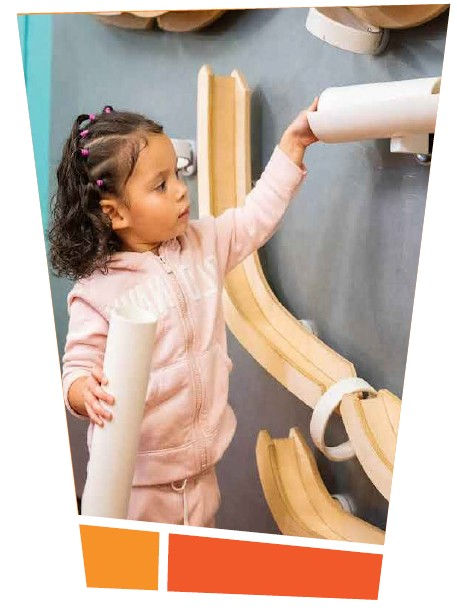
We start with scale. Children experience the world from a different height, a different angle, a different rhythm. When spaces are built at a child’s level, they feel ownership. They feel welcome. They feel like the environment was made for them and not borrowed from adults.
We design with clarity. Kids don’t need instruction manuals; they need invitations. A well designed space quietly suggests what is possible without telling them what to do. It offers open ended materials, intuitive pathways, and gentle transitions that help them understand where they are and where they can go next.
We choose materials that feel alive. Wood, fabric, metal, water, light, are all elements that carry texture, temperature, weight, and sound. Children learn through their senses, and natural materials give them something real to respond to.
We design for the adults, too. When grown ups feel comfortable and supported, they engage more intimately with their children. Clear sight lines, intuitive layouts, and places to pause make it easier for families to explore together.
Above all, we design for wonder, the kind of wonder that grows from the world that children already know. The Red River Valley’s seasons, North Dakota’s agricultural heritage, Grand Forks’ aviation legacy, and the region’s global leadership in UAS innovation all have helped shape the museum’s design. These aren’t themes; they’re the lived environments, lived experiences and lived moments of the families we serve. When children see elements of their own community reflected in the museum, wonder feels personal. It feels local. It feels like home.
This is the philosophy guiding every exhibit:
Build a place where children feel seen, capable, curious, and free to explore.
Build a museum that reflects the identity of Grand Forks and the broader North Dakota story.
Build a museum where STEAM comes alive through play, imagination, and hands‑on discovery.
Build a museum that grows with them.
Build a museum that belongs to every family who walks through its doors.

Katie Mayer, Executive Director, Grand Forks Children's Museum


Comments